
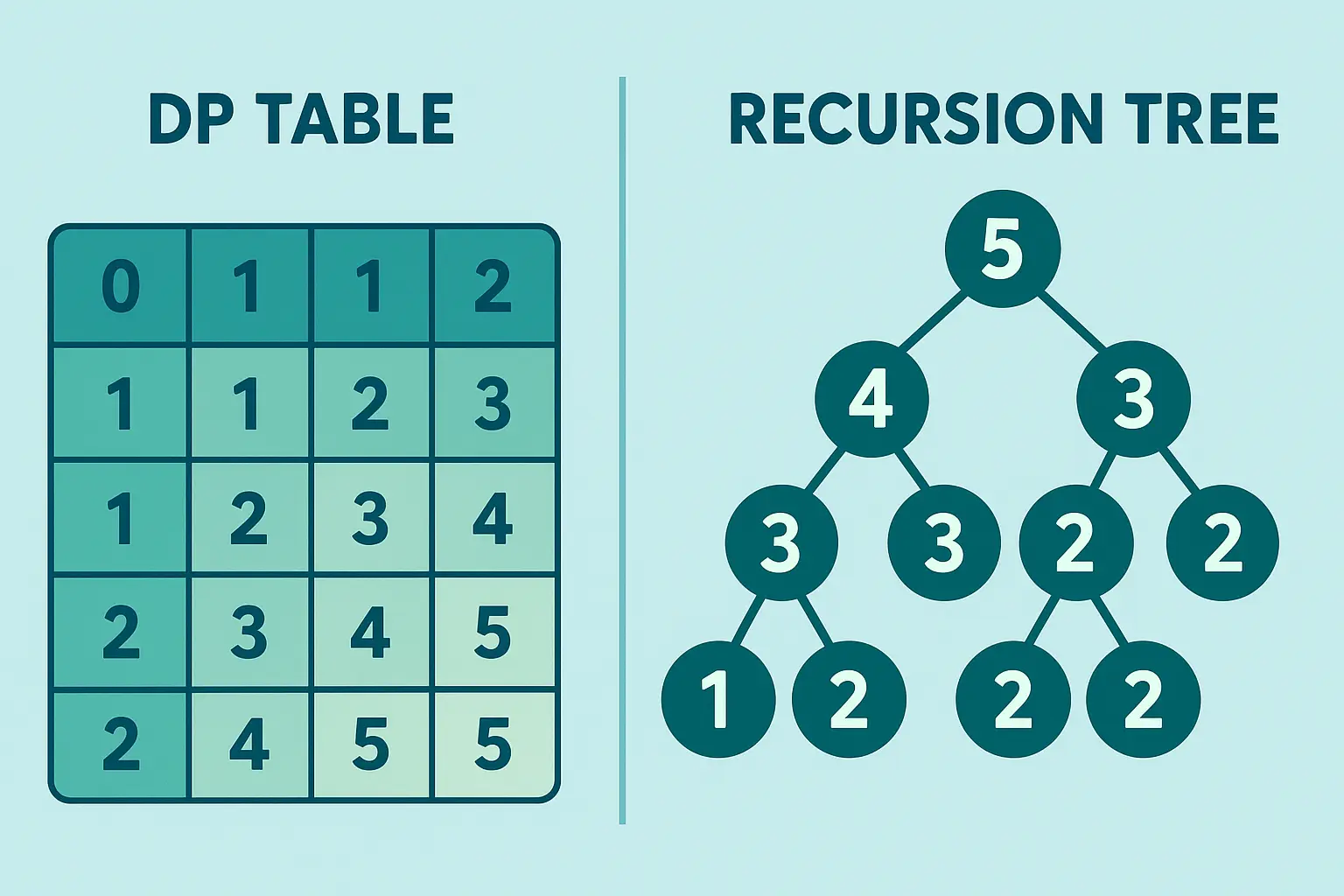
Dynamic Programming Tabulation Vs Memoization Michael Ouroumis Blog Dive into dynamic programming by exploring tabulation and memoization techniques. learn when to use each method, see code examples, and optimize your algorithms for performance and scalability. Tabulation and memoization are two techniques used to implement dynamic programming. both techniques are used when there are overlapping subproblems (the same subproblem is executed multiple times).

Dynamic Programming Tabulation Vs Memoization Michael Ouroumis Blog Master dynamic programming by comparing tabulation (bottom up) and memoization (top down). this guide covers key concepts, trade offs, javascript code samples, and best practices for interviews and real world projects. Master dynamic programming by comparing tabulation (bottom up) and memoization (top down). this guide covers key concepts, trade offs, javascript code samples, and best practices for interviews and real world projects. It covers two main dp approaches: memoization (top down) and tabulation (bottom up), with examples using fibonacci numbers and the house robber problem, where each approach demonstrates how caching intermediate results saves time by avoiding redundant calculations. While the memoization algorithms are easier to understand and implement, they can cause the stack overflow (so) error. the tabulation algorithms are iterative, so they don’t throw the so error but are generally harder to design.

Dynamic Programming Mastering Tabulation And Memoization Algocademy Blog It covers two main dp approaches: memoization (top down) and tabulation (bottom up), with examples using fibonacci numbers and the house robber problem, where each approach demonstrates how caching intermediate results saves time by avoiding redundant calculations. While the memoization algorithms are easier to understand and implement, they can cause the stack overflow (so) error. the tabulation algorithms are iterative, so they don’t throw the so error but are generally harder to design. In this comprehensive guide, we’ll explore two fundamental approaches to dynamic programming: tabulation and memoization. by the end of this article, you’ll have a solid understanding of these techniques and be able to apply them to solve a wide range of programming challenges. The two main approaches to implementing dynamic programming, memoization and tabulation, offer different trade offs in terms of time complexity and space complexity, and the choice between. Dynamic programming is typically implemented using tabulation, but can also be implemented using memoization. so as you can see, neither one is a "subset" of the other. Understanding differences between top down (memoization) and bottom up approach (tabulation) of dynamic programming will help us make critical decisions during problem solving.

Memoization Vs Tabulation In Dynamic Programming In this comprehensive guide, we’ll explore two fundamental approaches to dynamic programming: tabulation and memoization. by the end of this article, you’ll have a solid understanding of these techniques and be able to apply them to solve a wide range of programming challenges. The two main approaches to implementing dynamic programming, memoization and tabulation, offer different trade offs in terms of time complexity and space complexity, and the choice between. Dynamic programming is typically implemented using tabulation, but can also be implemented using memoization. so as you can see, neither one is a "subset" of the other. Understanding differences between top down (memoization) and bottom up approach (tabulation) of dynamic programming will help us make critical decisions during problem solving.
Comments are closed.