

Chegg Pdf Consider the robot given in figure 1. obtain the joint variables θ1 , θ2 (in degrees) and d3 (in meters), given the end effector position [0.5, 2, 2.5]t and link lengths 4, 5 and 6, all in meters. Consider the 3d manipulator shown below. draw a schematic of the manipulator, label the diagram with the appropriate coordinate frames and derive the forward kinematic equations using the dh convention.
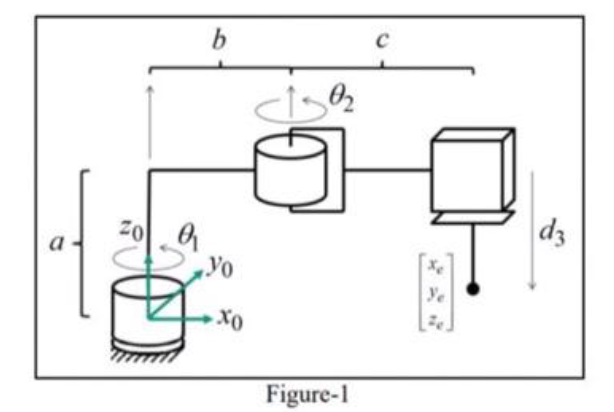
Solved Consider The Robot Given In Figure 1 Obtain The Chegg We then derive the dynamic equations of several example robotic manipulators, including a two link cartesian robot, a two link planar robot, and a two link robot with remotely driven joints. As a constant, the above is just a linear system of four equations and four unknowns (the ai’s), and it can be solved with a little simple algebra to yield: a0 = θ0 a1 = 0. Consider the robot given in figure 1. obtain the joint velocities θ˙1,θ˙2 (in rad s) and d˙3 (in m s ), given the end effector velocity [x˙ey˙ez˙e]t, the link lengths a,b,c, and the robot configuration θ1,θ2 (in rad) and d3 (in meters). Obtain the joint variables θ1,θ2 (in degrees) and d3 (in meters),given the end effector position [xeyeze]t and link lengths a,b and c, all in meters.figure 1can you solve this question showing the steps clearly and parametricly. your solution’s ready to go!.
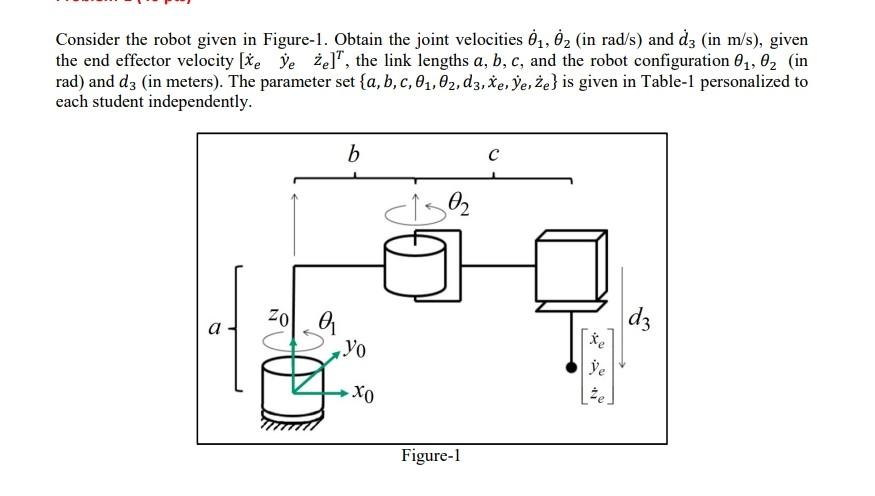
Solved Consider The Robot Given In Figure 1 Obtain The Chegg Consider the robot given in figure 1. obtain the joint velocities θ˙1,θ˙2 (in rad s) and d˙3 (in m s ), given the end effector velocity [x˙ey˙ez˙e]t, the link lengths a,b,c, and the robot configuration θ1,θ2 (in rad) and d3 (in meters). Obtain the joint variables θ1,θ2 (in degrees) and d3 (in meters),given the end effector position [xeyeze]t and link lengths a,b and c, all in meters.figure 1can you solve this question showing the steps clearly and parametricly. your solution’s ready to go!. consider the robot given i n figure 1 obtain the joint variables θ 1, θ 2 (i n degrees) and d 3 (i n meters), given the end effector position [x e y e z e] t and link lengths a, b and c, all i n meters. Receive 20 % off the first month of a new chegg study or chegg study pack monthly subscription. this offer requires activation of a new chegg study or chegg study pack monthly recurring subscription, charged at the monthly rate disclosed at your sign up. Problem 1 (20 pts)consider the robot given in figure 1. obtain the joint variables θ1,θ2 (in degrees) and d3 (in meters), given the end effector position [xeyeze]t and link lengths a,b and c, all in meters. solve on a hard copy with a clear hand write please. your solution’s ready to go!. The joint space q of a manipulator is composed of all possible values of the joint variables of the robot. this is equivalent to the con guration space of the robot.
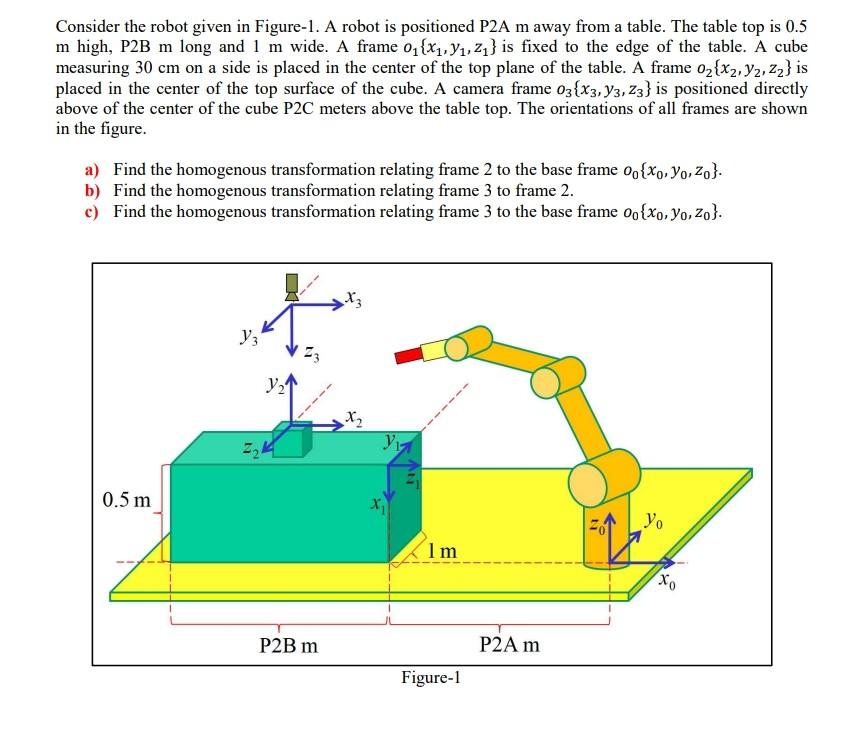
Solved Consider The Robot Given In Figure 1 A Robot Is Chegg consider the robot given i n figure 1 obtain the joint variables θ 1, θ 2 (i n degrees) and d 3 (i n meters), given the end effector position [x e y e z e] t and link lengths a, b and c, all i n meters. Receive 20 % off the first month of a new chegg study or chegg study pack monthly subscription. this offer requires activation of a new chegg study or chegg study pack monthly recurring subscription, charged at the monthly rate disclosed at your sign up. Problem 1 (20 pts)consider the robot given in figure 1. obtain the joint variables θ1,θ2 (in degrees) and d3 (in meters), given the end effector position [xeyeze]t and link lengths a,b and c, all in meters. solve on a hard copy with a clear hand write please. your solution’s ready to go!. The joint space q of a manipulator is composed of all possible values of the joint variables of the robot. this is equivalent to the con guration space of the robot.
Comments are closed.